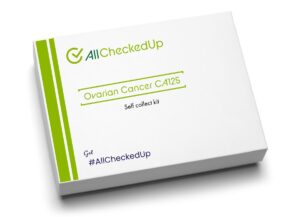
The CA 125 blood test remains the most widely used marker for ovarian cancer, and it is the blood test the UK health body NICE recommends for women aged 40 or over who have persistent symptoms suggestive of Ovarian Cancer. So how accurate is a CA125 test? And what is an abnormal test result?
The Ovarian Cancer CA125 test measures the amount of cancer antigen 125 in your blood. Unlike bowel and cervical cancer, ovarian cancer has no national screening programme in the UK. In this article, we will look at:
Ovarian cancer is cancer which starts in the ovaries or, as is now understood to be common, in the fallopian tubes. The ovaries are the two small organs which store eggs and produce female hormones.
It is the 6th most common cancer in women in the UK, with around 7,000 new cases every year, and it is estimated that 1 in 50 UK females will be diagnosed with ovarian cancer in their lifetime. It causes around 4,100 deaths a year, making it a more frequent cause of death than cancers of the uterus or cervix.
In its early stages, ovarian cancer may cause no symptoms, or if symptoms are present, they are quite vague, often been put down to far more common problems such as irritable bowel syndrome. Some early-stage symptoms that can occur include:
persistent bloating
feeling full soon after easting, or a general loss of appetite
feeling breathless or back pain
pain or pressure in the tummy or pelvic area
needing to pass urine more urgently or more often than usual
unexpected vaginal bleeding
unexplained tiredness, weight loss or a change in bowel habit
It is important to remember that many women with these symptoms do not have ovarian cancer, but it’s more likely, particularly in women over 50 years old, if symptoms are new, quite severe and occur most days, usually around 12 times a month or more.
Diagnosing ovarian cancer early is crucial for better health outcomes. More than 9 in 10 women diagnosed at stage 1 survive five years or more, compared with just 27% at stage 3 and 13% at stage 4. However, around 70% of cases are still diagnosed at a late stage, either stage 3 or 4, and each year, more than a quarter (29%) of all new ovarian cancer cases in the UK are diagnosed in people aged 75 and over.
CA125 is a protein which can be found on the surface of most ovarian cancer cells. Levels tend to be higher in women with ovarian cancer than in women without it, which makes CA125 a useful tumour marker, and remains the most widely used marker for ovarian cancer. CA125 currently has three distinct uses from helping to investigate women who already have symptoms, monitoring how a diagnosed ovarian cancer is responding to treatment. And it can help detect recurrence after treatment.
Our Ovarian Cancer CA125 Test is a quantitative test, meaning it reports an actual number rather than a simple positive or negative. This matters, because the number is what allows your result to be interpreted against the right threshold for your age as discussed in more detail below.
You can collect the sample yourself at home by finger prick or arm autocollect device, book a nurse home visit, or attend our Macclesfield or London clinics for a venous sample. Results are usually available within 48 hours of the laboratory receiving your sample.
What is a positive CA 125 test result?
Until recently, a positive result was fixed at 35 IU/ml or above regardless of age. However, following new research, the fixed figure was shown to be missing cancers in older women while triggering unnecessary investigations in younger ones. Therefore, it is now recommended that this threshold should be determined by age.
A raised result does not mean you have ovarian cancer. CA125 is produced by many tissues in the body, and a long list of entirely benign conditions can push the level above 35. In pre-menopausal women, a mildly raised result is far more likely to reflect something like endometriosis or a simple ovarian cyst than a cancer.
Equally, a normal result does not rule ovarian cancer out. Elevated CA125 is found in around 80% of women with ovarian cancer overall, and in roughly 90% of those with advanced disease — but only about half of women with stage 1 ovarian cancer have a level above the threshold.
NICE age-specific CA125 thresholds
The new updated guidelines on age-related threshold for determining a positive test result.
Age group (years)
CA125 threshold (IU/ml)
40 to 49
35 or greater
50 to 59
31 or greater
60 to 69
24 or greater
70 to 79
25 or greater
80 and over
31 or greater
Source: NICE guideline NG12, recommendation 1.5.9 and table 1
For women aged 39 and under, NICE now advises that CA125 should not be used in isolation to guide decisions, because the test is not accurate enough in this age group and risks false reassurance. Where a woman under 40 has persistent symptoms, an ultrasound scan should be considered as the first investigation instead.
What else may cause a raised CA125 result?
Endometriosis
Endometriosis occurs when tissue similar to the lining of the womb grows outside the uterus, often on the ovaries, fallopian tubes or the lining of the pelvis. It is one of the most common causes of a raised CA 125 in pre-menopausal women, particularly during menstruation, and can occasionally produce quite high readings.
Ovarian cysts and fibroids
Non-cancerous ovarian cysts and uterine fibroids are both frequent causes of elevated CA125. Ovarian cysts are extremely common, and the great majority cause no symptoms and resolve without any treatment at all.
Menstruation and pregnancy
CA 125 levels fluctuate across the menstrual cycle and are typically highest during a period. Pregnancy also raises CA125, especially in the first trimester. If you are pre-menopausal, taking your sample in the middle of your cycle rather than during a period will give a more representative result.
Pelvic Inflammatory Disease (PID)
PID is an infection of the upper female reproductive tract, usually caused by a sexually transmitted infection which has travelled upwards from the vagina or cervix. The inflammation it produces can raise CA 125, and PID itself needs prompt treatment to prevent longer-term damage to fertility.
Other inflammatory conditions
Because CA 125 responds to inflammation of the lining of the abdomen generally, a range of other conditions can raise it. These include liver disease and cirrhosis, diverticulitis, pancreatitis, heart failure, fluid on the lungs or in the abdomen, and recent abdominal or pelvic surgery. CA 125 can also be raised in some other cancers, including endometrial, cervical, breast, lung and pancreatic cancer.
How accurate is a CA125 test?
In women who already have symptoms, CA125 is a genuinely useful test. A large UK study of more than 50,000 symptomatic women, funded by Cancer Research UK and the NIHR, found that CA125 detected more than 77% of all ovarian cancers and more than 85% of the invasive ovarian cancers most likely to prove fatal. This is the setting the NICE thresholds above are designed for.
Advanced testing using the ROMA (Risk of Ovarian Malignancy Algorithm) test
The ROMA (Risk of Ovarian Malignancy Algorithm) test is a blood test used to help assess the likelihood that an ovarian mass is cancerous. It combines the results of two tumour markers, CA125 and HE4 (Human Epididymis Protein 4), together with whether a woman is pre- or post-menopausal, to estimate the risk of epithelial ovarian cancer, the most common type of ovarian cancer.
Research has shown that ROMA has good accuracy for detecting epithelial ovarian cancer and may improve risk assessment in some women, particularly when compared with CA125 alone.
Frequently asked questions
What CA125 level is considered normal? Most UK laboratories use 35 IU/ml as the upper limit of normal, and the reference range printed on your report is the one that applies to your sample. Since March 2026, updated guidelines by NICE advised a lower, age-specific thresholds for women aged 50 and over when deciding whether to arrange an ultrasound.
Does a raised CA125 mean I have ovarian cancer? No. Many benign conditions raise CA125, including endometriosis, ovarian cysts, fibroids, menstruation, pregnancy and pelvic infection. A raised result is a reason to investigate further, not a diagnosis.
Does a normal CA125 mean I definitely don’t have ovarian cancer? No. Around half of women with stage 1 ovarian cancer have a normal CA125. If you have persistent symptoms, you should get all checked up with your GP regardless of your result.
When in my cycle should I take the test? If you are pre-menopausal, mid-cycle rather than during a period will give a more representative result.
How quickly will I get my results? Results are usually available within 48 hours of the laboratory receiving your sample.
What happens if my result is raised? We will contact you to explain the result and provide a free referral letter from our GPhC-registered pharmacist which you can give to your GP for further investigation.
The All Checked Up Comprehensive Cancer & Gut Inflammation Screening Test provides an all-in-one screening and health test focused on gut health and cancers. In
Book an in-person, phone or video consultation with one of our Pharmacists or clinicians to discuss what blood or health screening test is best for you. The consultation fee is deducted from any subsequent blood test you book with us following the consultation